As usual, at the beginning of the growing season, the Vineyard Vademecum 2025 is available, the result of collaboration between the Prosecco DOC and Vini Venezia Consortia and with the valuable contribution of Fiorello Terzariol.
The Vademecum is an easy and concrete tool to better plan vineyard defence and introduces the Prosecco DOC Consortium’s path towards Sustainable Denomination.
Click here to download the Vademecum-Viticolo-2025.
For further information contact the Consortium offices: ricerca@consorzioprosecco.it
THE CONSORTIUM STARTS EXPERIMENTATION ON LOW-ALCOHOL SPARKLING WINES
On the occasion of Vinitaly, in the Prosecco DOC Theatre (Stand B4, Hall 4), the Consortium for the Protection of Prosecco DOC, in collaboration with the University of Padua, presented the first results of the project, “Prosecco Low-Alcohol,” launched in 2024, aimed at investigating the characterizing elements of a sparkling wine production having an actual alcohol content between 8 and 9 degrees and a low residual sugar.
“To date,” comments Consortium President Giancarlo Guidolin, ”within our specifications, sparkling wines with low alcohol content (about 8.5 percent vol.) are allowed, but, obligatorily, with high residual sugar (demi-sec version). The objective of the experimentation, therefore, is to evaluate a sparkling wine, Glera-based, with an alcohol content of 8-9% vol. and residual sugar in line with market preferences, namely brut and extra dry.”
“The first results obtained during experimentation have been positive, in line with expectations,” says Simone Vincenzi, Professor at the University of Padua. ”It is important to emphasize that this is not a dealcolation process, but a different management of fermentation, both during vinification and sparkling, so that only the sugars naturally present in the grapes can be converted into alcohol.
“The Consortium,” Guidolin concludes, ”has always been attentive to the evolution of the market and new consumption trends. With this experimentation we want to carefully evaluate, first in the Council, then in the Assembly, the opportunity to be able to respond to the demands of the new generations and of a public increasingly attentive to nutritional issues and conscious wine consumption , without, however, losing the identity and peculiarities of our Denomination.”
The Consortium presents new research on the genetics of the Glera variety
On the occasion of Vinitaly, in the Prosecco DOC Theatre (Stand B4, Hall 4), the Consortium for the Protection of Prosecco DOC welcomed its partners from the University of Padua and CREA (Council for Research in Agriculture and Analysis of Agricultural Economics) to announce the activities being developed on the broad topic of genetics. In fact, in accordance with current regulations, two initiatives are pushing the frontiers of this subject, with the aim of ensuring an increasingly sustainable and climate change resilient viticulture.
The first, with the Gleres project (investment of €160,000), aims to obtain, through crossbreeding, a new variety that can preserve the characteristics of the parental varieties, i.e. the sensory profile of the Glera and the resistance elements of the other variety. Productions of the first ‘daughter’ variety of Glera, registered under the name Glaurum, were tasted today at the stand.
The second initiative, with the Glera 2.0 project (investment of € 270,000 by 2025), aims to investigate the application of Assisted Evolution Techniques (TEA) directly on the Glera variety, with the objective of improving its resistance without altering its genetic identity and, therefore, its characterising qualitative peculiarities.
Giancarlo Guidolin, President of the Consorzio di tutela della DOC Prosecco, states:
‘This research represents an important opportunity for our sector. The adoption of advanced genetic improvement techniques could allow us to face the future challenges of viticulture without compromising the tradition and quality that characterise our product. Our commitment is to guarantee sustainable wine production, both environmentally and socially, ensuring the degree of excellence recognised by consumers worldwide.’
Alessandro Vannozzi, Professor at the University of Padua, and Riccardo Velasco, Director of CREA, comment:
‘This collaboration between the Consortium, the CIRVE of the University of Padua and CREA is fundamental for the progress of viticulture in the Prosecco DOC territory. The Consortium’s focus on genetic improvement, both conventional and through assisted evolution technologies (TEA), shows a clear desire to respond to the challenges of the sector by focusing on research and innovation. The main objective of the Glera 2.0 project is to lay the foundations for the application of TEA to the Glera variety, which is strongly identified with the territory. Exploiting the potential offered by these new technologies represents a crucial step for the improvement of this variety, not only in terms of resistance, but also for the maintenance of its quality characteristics threatened by climate change.’
Dedicated loans from the Bank’s EUR 3 billion credit line, specialist consultancy and local meetings on sustainability and ESG requirements to facilitate access to credit for companies in the Prosecco chain
The Prosecco DOC Consortium and Crédit Agricole Italia have signed an agreement aimed at promoting the adoption of sustainability practices by member companies and the entire production chain. The agreement was signed in Verona, within the framework of Vinitaly at the Prosecco DOC Theatre (stand b4, hall 4), by the President of the Consortium Giancarlo Guidolin and the Head of Banca d’Impresa of Crédit Agricole Italia, Marco Perocchi, in the presence of the Director of the Consortium Luca Giavi.
The initiative, aimed at an audience of around 11,400 Consortium members made up of winegrowers, winemakers and bottlers, provides for a dedicated line of financing from the EUR 3 billion ceiling allocated by the Bank following the memorandum of understanding signed in February with the Ministry of Agriculture, Food Sovereignty and Forestry (MASAF).
In addition to dedicated finance, Crédit Agricole Italia will support companies in the supply chain with a range of tools to facilitate the transition towards sustainable agricultural and production practices, such as the evaluation of the ESG level, specialist consultancy services, and the organisation of information and training meetings in the area. Particular attention will be paid to supporting young people in one of the most delicate challenges for businesses, the generational transition.
Marco Perocchi, Head of Corporate Banking at Crédit Agricole Italia, said:
‘The adoption of methodologies for analysing and certifying sustainability performance and compliance with ESG requirements is an opportunity for companies as the evolution of consumption and the growing sensitivity to sustainability issues, as well as the evolution of EU regulations, require a careful monitoring of information related to the value chain. Accompanying the operators in the chain in the production of this information and more concretely in the sustainable transition is now part of the role of advisor that the Bank now exercises in parallel with its credit and financial activities.’
Luca Giavi, Director of the Consorzio di tutela della Doc Prosecco, commented:
‘We consider it strategic for our consortium members to embark on a path aimed at certification and the application of ESG logics, in order to better position the Prosecco system in the markets and consumer perceptions, as well as to facilitate easier access to financial levers.’
Consortium President Giancarlo Guidolin added:
‘In recent years Crédit Agricole Italia and the Consortium have consolidated, with mutual satisfaction, a relationship of collaboration on various initiatives aimed at companies in the wine sector. This further agreement strengthens our partnership and allows us to further develop the research and innovation activities aimed at the path of sustainability that we pursue with confidence and commitment’.
Confirming its role as a reference point for the sector, in 2024 Crédit Agricole Italia recorded an increase in Agri-Agro lending of +3.3% y/y, against a shrinking market. Market share in the sector increased by +11 basis points y/y to close to 8%.
On the occasion of Vinitaly, at the Prosecco DOC Theatre (Stand B4, Hall 4), the Consortium for the Protection of Prosecco DOC and Veneto Agricoltura presented AmpeloPros, a project launched at a strategic moment for the wine sector in terms of attention to environmental sustainability and market supply.
Nicola Dell’Acqua, Director of Veneto Agricoltura, declared:
‘The impacts of climate change on agricultural crops are increasingly evident and, in the case of wine, are affecting the organoleptic and sensory characteristics of grapes and therefore wines, with the risk of changing the product’s distinctive characteristics. In this experimental project, Veneto Agricoltura’s contribution is to collaborate with the Prosecco DOC Consortium by providing many years of experience in wine-growing and wine-making experimentation conducted both on varieties resistant to fungal diseases (PIWI) and on native grape varieties. In addition, the Agency’s Pilot and Demonstration Agencies are carrying out experimental vineyards useful for identifying vine varieties potentially capable of integrating with the ampelographic base envisaged by the specification of the denomination and satisfying the characteristics of freshness and aromaticity that distinguish Prosecco DOC. Lastly, sensory analysis tests are underway to verify the typicality of Prosecco DOC wine: at Vinitaly 2025, a tasting of an initial selection of wines was organised.’
In addition to pure Glera, the tasting included several blends between Glera at 85% and varieties with a high acidic component such as Raboso Piave at 15%, and with resistant varieties such as Johanniter, also at 15%.
Consortium President Giancarlo Guidolin comments:
‘Climate change is forcing the wine sector to make strategic choices and innovative solutions to protect the identity and quality of its products. This project is part of a path of research and experimentation that is fundamental for the future of DOC Prosecco. Thanks to the scientific and technical contribution of Veneto Agricoltura, the Consortium reinforces its commitment to sustainability and safeguarding the territory, ensuring the Denomination a future worthy of its tradition and the international market.’
On Sunday afternoon at Vinitaly, in the Prosecco DOC Theatre (Stand B4, Hall 4), the Prosecco DOC Consortium had the pleasure of hosting Sandro Sartor, President of Wine in Moderation, of which the Consortium has been National Coordinator for the past year.
Founded with the aim of promoting a healthy and conscious lifestyle, particularly in the moderate consumption of wine, the association has always stressed the importance of the Mediterranean Diet as a nutritional model recognised worldwide for its benefits on health and longevity. In this context, wine has historically occupied a prominent place, representing not only an element of conviviality, but also a cultural expression of territories and traditions.
Indeed, numerous scientific studies show that moderate wine consumption, as part of a healthy lifestyle – based on the Mediterranean Diet, quality rest and adequate physical activity to counteract sedentariness – can contribute to a state of general well-being, thanks to the presence of polyphenols and other antioxidant substances. However, the key concept remains moderation in every aspect, as was amply stated at the recent “Lifestyle, Diet, Wine and Health” Congress held in Rome from 26 to 28 March, organised by the Wine Information Council, IRVAS and Wine in Moderation with the support of Prosecco DOC.
Statements
“The Mediterranean Diet,” says Sandro Sartor, President of Wine in Moderation, ‘is an invaluable heritage. Wine, consumed in moderation and within a balanced diet, is an integral part of it, in line with the tradition and wellness principles it promotes. Wine in Moderation aims to spread the culture of responsible consumption, aware of the value that wine can have if it is included with measure in a correct lifestyle.”
Reiterating this commitment, the President of the Prosecco DOC Consortium, Giancarlo Guidolin: “We are proud to be an active part of Wine in Moderation and to support its message of conscious consumption. Our Denomination has always had at heart the promotion of a balanced approach to wine, in harmony with the principles of the Mediterranean Diet, recognised by UNESCO as an intangible asset of humanity. We believe that educating consumers to moderation is essential to enhance the quality of our product and the wellbeing of those who choose it. Vinitaly represents a precious opportunity to spread this culture and strengthen the link between tradition, territory and responsibility.”

A new model of innovation and sustainability for Prosecco DOC
In order that the results of the research projects developed by the Consortium and its partners may be disseminated in a timely manner with all operators and with the aim of ‘listening’ to the needs of the supply chain, as well as communities and all stakeholders, the Consortium presented the project L.I.St.En.In.G – The Stakeholders Engagement IT Approach for Innovation and Governance – an initiative that manifests an innovative vision, oriented towards a future that embraces words such as sharing and cohesion.
The project aims to create a strategic organisational model and an interactive IT platform to actively engage all stakeholders of the denomination and build a collaborative ecosystem.
Financed under the Regional Complement for Rural Development of the National Strategic Plan of the CAP 2023-2027, with a total investment of 149,960 euro, the L.I.St.En.In.G project sees the involvement of two partners: the Interdepartmental Centre for Research in Viticulture and Oenology (CIRVE) of the University of Padua and PSR & Innovazione Veneto S.r.l. – Consulting Organisation recognised by the Veneto Region and enrolled in the National Register kept by the Ministry of Agriculture, Food Sovereignty and Forestry.
Planned actions
Involving various experts to define the design of stakeholder engagement.
Set up listening points to collect the needs and feedback of companies and the territory, favouring dialogue between producers, researchers and institutions.
Implement consultancy and demonstration activities for wine-growing companies to provide information and innovative protocols generated useful for perfecting sustainable vineyard management, both in lowland and hillside companies, from the point of view of plant protection, water resource availability and nutrient management through appropriate grassing and organic fertilisation management.
Expected results
Improve management and awareness of their social, environmental and economic impact on the territory.
Understand and prioritise Stakeholder needs.
Promote a cultural change in the approach to sustainability.
For more information contact the Consortium at ricerca@consorzioprosecco.it


The Consorzio di Tutela del Prosecco DOC and Veneto Agricoltura have launched an experimental project, called AMPELOPROS, aimed at testing several grape varieties, both already grown in the Italian territory and new varieties resistant to the main vine diseases, in two areas in the territory of the denomination.
After the experimentation – in the presence of results that manage to ensure, on the one hand, the identity and peculiarities of the Denomination and, on the other hand, an advantage in terms of sustainability for the territory – the Production Chain, considering the principles underlying the recognition of a denomination of origin, will be able to assess whether or not to expand the ampelographic base of the production specification.
Nicola dell’Acqua, Director of Veneto Agricoltura
“Our agency is part of the Ampelopros project by providing many years of experience in viticultural and oenological experimentation conducted on fungal disease resistant varieties (PIWI) and native grape varieties. In particular, experimental vineyards will be planted in the pilot holdings of Veneto Agricoltura. Subsequently, with micro vinification and micro sparkling wine blending, the intention is to identify vine varieties potentially capable of integrating with the ampelographic base envisaged by the Prosecco DOC specification. Veneto Agricoltura will also have the role of training a specialised sensory analysis group to verify the typicality of Prosecco.”
Giancarlo Guidolin, president of the Prosecco DOC Consortium
“This agreement with Veneto Agricoltura represents a fundamental step for the enhancement and protection of the Prosecco DOC denomination in a context of climate change. Our mission is to support the Prosecco wine and wine sector with projects that can ensure competitiveness and sustainability. An international context such as Wine Paris,” the President concludes, ”represents the right opportunity to reaffirm the commitment of the Consortium and its entire Chain in creating synergies between science and business for the benefit of the territory and communities.
With the Paris fair, thanks to the discussion with the operators, it was possible to detect the first impressions for this new commercial campaign, both for the international and the French market, which, since 2018, has been growing every year in double digits. In fact, concludes the President, “the January bottlings started with a positive sign and from what we were able to observe, France greatly appreciates our product, particularly for its organoleptic-sensory profile marked by freshness and versatility.”
The project will be realised thanks to the public contribution obtained through the Veneto ERDF 2021-2027 PR funding issued by the Region through DGR 729/2024 concerning Action 1.1.1 – Sub A ‘Strengthening research and innovation between enterprises and research organisations’ and envisaged for the Regional Innovative Networks (RIAV) within the IN.TE.G.R.A. project.
The effects of climate change are becoming more and more evident year by year, from the drought of 2022 to the hailstorms of 2023, to the alternating rainfall and high temperatures in 2024. How might the climate evolve in the coming years? What countermeasures can be taken?
SISOVI, which stands for Innovative Solutions for Sustainable Strategies and Business Models in the Wine Sector, wants to answer these questions. As a matter of fact, thanks to the development of a predictive model of the evolution of the climate (rainfall and temperature), it aims to identify in advance the areas that could present a greater degree of risk and, at the same time, the agronomic practices to cope with these negative effects, with the objective of safeguarding the production of Prosecco from a qualitative point of view.
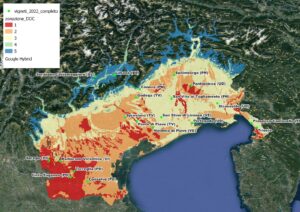
The project, conceived and coordinated by CREA (Viticulture and Oenology Research Centre) and the Prosecco DOC Consortium, financed through the Cascata iNest (Interconnected Northeast Innovation Ecosystem, funded by NextGeneration EU) with a contribution of EUR 80,951, will run until 2025.
Planned actions:
- historical analysis of the climate in the Denomination territory
- analysis of the organoleptic characteristics of the grapes
- comparison and evaluation of agronomic practices in relation to different climate data
Expected results:
- to delineate the areas most at risk of climatic evolution
- to share with the production chain ad hoc vineyard management indications in relation to one’s own area
For further information write to ricerca@consorzioprosecco.it
Project funded by NextGeneration EU