Treviso, November 27, 2025 – The results of the MORE Project (Microorganisms for Energy Saving in Oenology) have been announced. This initiative was developed by the Prosecco DOC Consortium and CREA – Center for Research in Viticulture and Oenology, thanks to the contribution of the Cascata iNest (Interconnected Northeast Innovation Ecosystem) call for proposals. The project involved scientific partners such as Vassanelli LAB, the University of Milan (UniMi), and seven local wineries (Vinicola CIDE, Masottina, Cantina di Conegliano, Vittorio Veneto e Casarsa, Casa vinicola Bosco Malera, Azienda Vitivinicola Ornella Bellia, Perlage Winery, Pitars).
MORE has identified innovative protocols which, by regulating sparkling wine production at higher temperatures than traditional standards, reduce energy consumption, cutting costs and environmental impact without altering the sensory profile of the product.
Giancarlo Guidolin, President of the Prosecco DOC Consortium, commented:
“We are very satisfied with the results achieved, which will undoubtedly improve the environmental impact of the Denomination. This project is part of a series of research and innovation initiatives developed by the Consortium—in collaboration with universities, research centers, and companies, whom I sincerely thank—dedicated to both wine-growing and wine-producing companies. Progress in the field of sustainability is increasingly important and positive: we will continue in this direction, not only by operating appropriately in the vineyard phase, but also by embracing the winery and related sectors, for a 360-degree approach to the territory.”
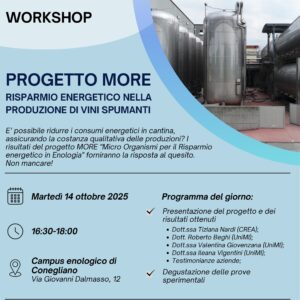
At the closing event, held in the Aula Magna of the Conegliano Wine Campus, the results of the project were presented, offering those present the opportunity to taste the results of the various experiments. In particular, it was demonstrated that in the sparkling wine production phase, by following the experimental protocol, it is possible to reduce the energy used in secondary fermentation by an average of 24%, obtaining products that are almost comparable to those made with traditional protocols, but with a significant reduction in costs and environmental impact.
Project funded by NextGeneration EU